Part 1: Introducing C.ai, a redefinition of the Compensation workflows
For the past five years, I’ve been conducting academic research in pursuit of a doctoral degree in Artificial Intelligence. My work has focused on one central question: How can AI become a true partner in Human Resources?
That journey led me to turn research into reality to test ideas by creating C.ai (/kaɪ/) — short for Compensation and AI — a practical implementation of AI within the HR domain of Compensation and Benefits.
The purpose of this article is to provide a high level overview and share the key design principles identified during my research. These are the features that I believe an AI-driven compensation system should include, so practitioners can apply these insights within their own organizations and business contexts. C.ai was developed purely for academic purposes to help others with some insights for their own implementation projects.
The goal in developing C.ai was not to build just another AI tool, but to design an integrated framework, an application of the research I’ve explored, showing how AI can be seamlessly (and responsibly) embedded into the daily flow of decision-making, bringing together both intelligence and humanity in compensation processes.
👩💼 Imagine this…
Anne, Compensation Lead at a large global technology company, starts her day. She opens her AI partner tool. Overnight, it has summarized new regulations, market data, and new emails into a clear morning brief, and created a prioritized action plan for the day. Then an alert appears on her screen:
⚠️ “Unusual attrition trend detected in New York data scientist roles.”
Anne types a single instruction:
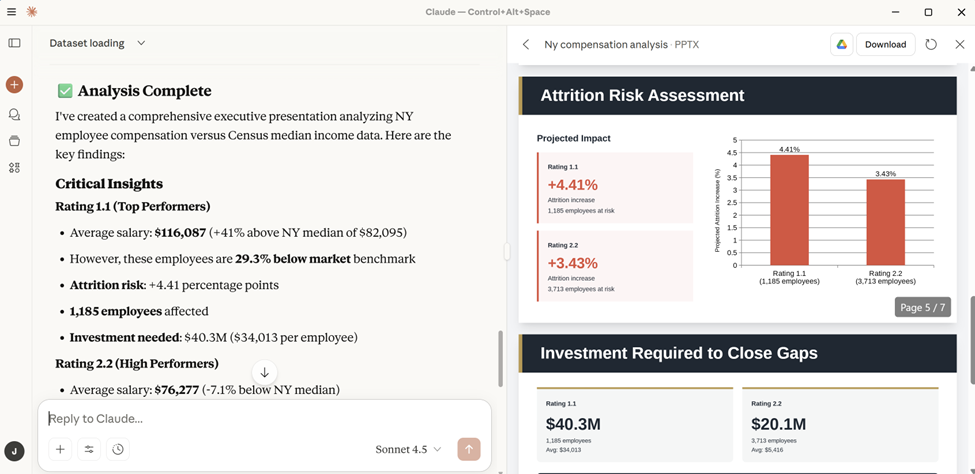
“Compare salaries of NY, data scientist employees to the market median. If below, estimate attrition risk for the next 12 months, calculate the investment to close the gap for the whole population and also just for employees who achieved a rating of above expectations. Also run a pay equity analysis by gender and race. Generate a PowerPoint and a short email summarizing the issue, investment and recommendations.”
Minutes later both the presentation and executive email are ready. Anne reviews, makes adjustments, adds final recommendations and sends by email. No searching for data. No spreadsheets. No downloads. No manual merges. Just insight, action and impact.
That’s not the future, you could develop this now.
🌟 The Vision Behind C.ai
In recent years, the application of AI in Human Resources has grown rapidly, from predictive models that forecast turnover or performance, to agentic systems that assist with recruiting or customer-facing processes.
This progress has been exciting, but it has also led to an overwhelming number of tools, many of which address narrow problems or just add AI layers to existing platforms.
C.ai takes a different approach. It’s an Agentic Intelligence Platform and Ecosystem, designed not to replace HR work, but to partner with it. Understands goals, plans its own steps, executes analyses, and delivers insights that make sense to humans. It shows how AI can integrate with, rather than simply augment complex organizational decision-making.
🧭 Redefining the compensation professional workflow
C.ai was built on eight design principles that define the new type of compensation work:
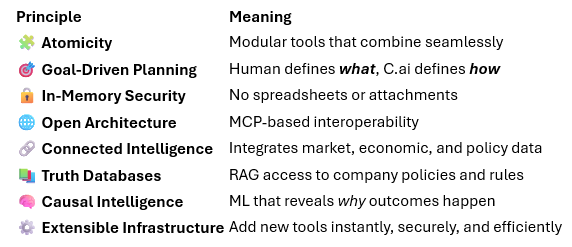
⚙️ 1️⃣ Atomic design — Small tools and skills, big possibilities
Your AI agents and solutions should not be monolithic platforms. C.ai it’s built from a large set of atomic tools, these are small efficient pieces of code like: search data, load data, filter by, group by, select from, plot a and b by x and y, predict Y on X, read, export, etc.
Each does one thing exceptionally well. They can be combined dynamically in layers depending on the problem. They form an ecosystem that can attempt to solve any compensation question, simple or complex.
This modular design makes it fast, explainable, and very flexible, mirroring how compensation professionals think and work.

🧠 2️⃣ The Human says the goal, your AI agent should figure out the rest.
No prompt engineering to learn. No presets to use. No coding to add. No forms to fill. No files to attach. The human simply says what he or she wants, and your AI system should do the rest.
At the core of a C.ai there is a planning engine that orchestrates steps. It interprets human intent, determines the optimal approach, and dynamically selects which analytical tools to call to produce what the human is looking for. The planner is model-agnostic, and it seamlessly adapts to leading frontier large language models such as OpenAI’s GPT or Anthropic’s Sonnet, leveraging their increasing reasoning capabilities to adapt to the realities and complexities or real business problems.
As LLMs continue to evolve in comprehension and reasoning, frameworks like C.ai can harness that intelligence to achieve precise, explainable, and goal-oriented outcomes, bridging the gap between human intent and machine execution.
When Anne says: “Model next year’s bonus distribution under a 3% lower budget and simulate attrition risk,”
C.ai proceeds to: 1️⃣ Search and retrieve the data 2️⃣ Calculates compa-ratios and market gaps 3️⃣ Runs simulations 4️⃣ Visualizes results 5️⃣ Produces an executive summary
💬 Goal-driven AI: The human defines what, the AI decides how.
🔒 3️⃣ Secure and efficient data handling
Compensation data is among the most sensitive information any organization manages. It holds details about pay, performance, and personal identity. This is data that if mishandled, can expose companies to regulatory sanctions, reputational damage, or loss of employee trust.
C.ai was built with this reality at its core. All computations occur entirely in memory. There is no need for the human to load and transform data in spreadsheets. When an analysis is requested, it retrieves only the data necessary to complete the task, performs calculations inside an isolated environment, and then discards the temporary working set once the task is complete. If allowed by parameter settings, humans can export results for further distribution.
Because there are no direct human downloads from systems, no attachments to include, and no uncontrolled copies, sensitive pay data never leaves the protected environment. C.ai can be configured so no sensitive data travels to the external LLMs in each API call, and the LLM is only used for reasoning and tool selection. That is a design option to consider, although it would reduce data insight capabilities and the ability to solve more complex queries.
During my research I also considered adding anonymization tools to eliminate personal information before the external LLM api call was made. Another option could be to use open-source LLMs like Meta’s Llama and many others available which could be deployed internally within the company walls. These are options to consider in your own agent development. At the end the system should be configured to what the human wants and is allowed to do.
Every query and transformation can be auditable, with traceable execution logs that show what data was accessed, by whom, and for what purpose. This level of control reduces the single biggest risk in compensation analytics, which is the uncontrolled movement of data across people, files, and systems.
In practice, this means HR and Compensation teams can analyze, compare, and present information with confidence, knowing that a system like C.ai enforces governance and top level security without slowing down their work.
🌐 4️⃣ Open architecture (MCP integration)
C.ai is built on Model Context Protocol (MCP), which is a newer and promising new open standard that lets AI systems talk to each other. This means any internal app which supports MCP or externally available tools like Anthropic’s Claude Desktop can securely talk with each other and access each others tools and data in real time, expanding their capabilities in an efficient and controlled way.
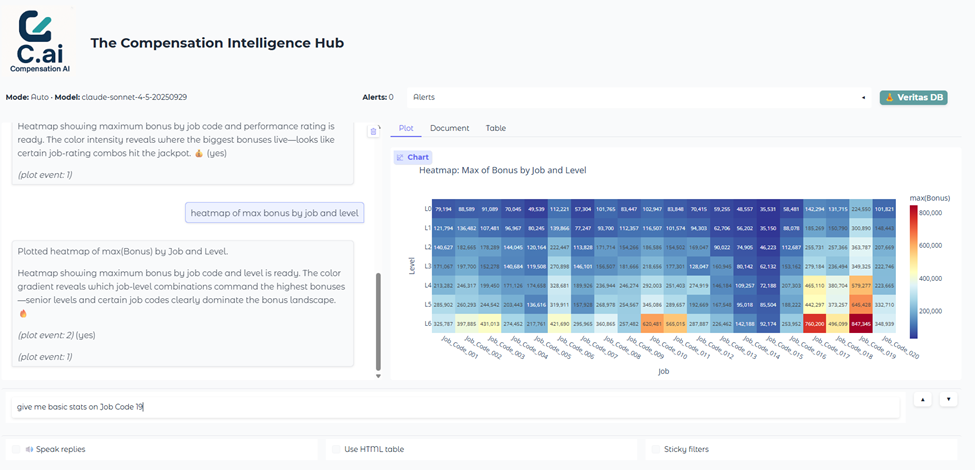
Throughout my research I found that the Claude Desktop + C.ai combination was extremely powerful and offered the possibility of solving much more complex queries than what it could be solved within the native C.ai user interface.
You could for example connect to internal MCP servers (HRIS, Finance, Risk, Policy, Payroll), creating a unified enterprise AI layer. C.ai doesn’t replace systems. It connects them.
🔗 5️⃣ Connected intelligence
C.ai can safely and efficiently extend beyond company walls. By linking with external MCP servers, it can access things like: market salary data, economic indicators, regulatory filings, research publications and many more.
For the current implementation, C.ai was linked to the US Census Bureau for US census data, and also to EDGAR for regulatory company filings.
When the human asks for something, the planning core understands where is the proper place to get it from. The multiple sources are integrated to complete the human’s request. These capabilities turn a system like C.ai into a connected intelligence network, where every piece of data in the context is used to complete the goal.
📚 6️⃣ Truth databases — Built-in organizational memory
Ask HR professionals for example what is the current calculation mechanics for certain type of ad hoc action … Don’t be surprised if they point to a few PowerPoint presentations, a couple SharePoint folders, a few inboxes or point you to a few people.
An AI system like C.ai can change that.
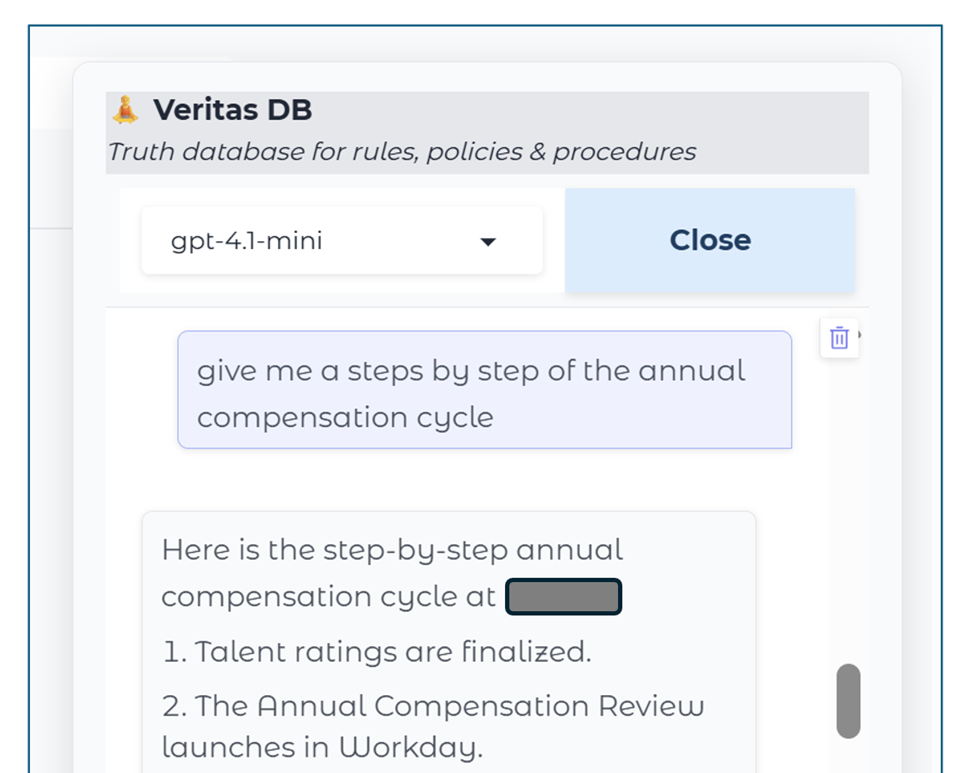
Using Retrieval-Augmented Generation (RAG), it retrieves not only formally documented policies and procedures, but expands the concept to offer the possibility of a living truth and knowledge database that can feed from internal team interactions and decisions.
C.ai has a data ingestion engine which can ingest information from different sources like MS office documents, internal websites and emails. It can be adapted to keep historical records of how different truths have evolved through time. Imagine asking:
“What’s the current rule to calculate retention bonuses for employees at the VP and Director level and how has it changed in the last few years.”
The AI answers:
“Current internal mechanism is retention bonuses apply to employees at the VP and Director level with ≥3 years tenure, capped at 15% of base salary. This procedure has been in effect since November 2021. Before that, the internal rule was to cap retention bonuses at 25% with tenures ≥5 years, which was in effect since December 2011. Do you want me to dig deeper if there is information why the procedure was changed?”
No searching. No guessing. Just authoritative answers.
📈 7️⃣ Advanced prediction and causality analysis
Most analytical systems in HR stop at associations and prediction: they can tell you what happened and sometimes what might happen next. AI systems for compensation should go further, they should help understand why. They should guide strategy by explaining the effect of a specific action.
C.ai integrates a causal inference engine that applies advanced statistical methods such as Double Machine Learning, Propensity Score Matching, and Double Robust Estimation to uncover the true drivers of pay outcomes, performance, and attrition.
Instead of simply predicting that attrition will rise when pay falls behind market, C.ai quantifies the magnitude and causal direction of that relationship, isolating how much of the effect is due to compensation itself versus other factors like performance level, tenure, or location.
For example, a user might ask:
“What is the attrition impact by performance level for employees in Florida if this year’s increase is 1% below market expectations? Calculate the cost of attrition versus the salary savings.”
Within seconds, C. ai performs the complete analysis, identifying treatment and control groups, adjusting for confounders, estimating causal effects, and computing the financial trade-off between retention risk and compensation savings.
By combining econometric techniques with generative reasoning, C.ai transforms standard reporting into evidence-based decision support, where every insight is statistically grounded, explainable, and actionable.
This is where data becomes evidence, and evidence becomes strategy.
🧩 8️⃣ Seamless integration of new tools and skills
Innovation shouldn’t take months or require massive budgets. C.ai was designed as both an ecosystem and a framework, enabling developers and analysts to extend its capabilities with bare-bone applications, lightweight modules that plug directly into its secure data, visualization, and execution layers.
These add-ons don’t need to build their own interfaces or handle user interaction. Once integrated, they immediately become part of C.ai’s natural-language skill set, accessible to humans through the same conversational experience as any existing feature.
This architecture makes expansion fast and efficient. A new pay-equity metric, regional compensation model, or workforce simulation can be created and deployed in hours, not months, instantly available to those who need it.
Every new capability can be customized by role and responsibility. Senior compensation leaders might have access to advanced modeling tools, while regional HR teams use the same framework with scoped features aligned to their function.
This design ensures that innovation happens continuously and responsibly, empowering creativity while maintaining control, security, and compliance.
⚡ From idea to impact, without complexity.
💼 Beyond features — A new way of working
For years, compensation professionals have spent most of their time managing processes rather than shaping outcomes. The “old world” meant searching for data, downloading files, merging spreadsheets, checking for errors, explaining formulas, and formatting slides. Performing work that was accurate, but rarely strategic.
In the “new world” those mechanical steps are replaced by intent-driven interaction. You ask questions, get answers, explore scenarios, and make decisions, all within a system that understands your context and goals.
The design of your Comp AI system should shift compensation work:
➡️ from Execution → Intelligence ➡️ from Reporting → Advising ➡️ from Tools → Transformation
It turns the compensation function from a back-office operation into a center of insight and foresight, it becomes one where AI amplifies human expertise instead of replacing it.
In this new design, analysts spend less time proving what happened and more time designing what should happen next.
🌟 Other highlights included in the design of C.ai to consider in your own implementation
✅ Real-time monitoring and alerts: Detect anomalies in pay, attrition, or equity.
✅ Interactive Dashboards: Visualize and interact with all plots.
✅ Integration of common tools: Summarize emails. Integrate them within your workflow
✅ News integration: Summarize and integrate relevant news by topic or importance.
💬 Final Thought
Tomorrow’s compensation leaders won’t open three spreadsheets or spend hours merging data and preparing PowerPoint slides. They’ll open a system like C.ai and simply say:
“Show me what matters.”
And the AI system will already know, not because it replaces human judgment, but because it was designed to enhance it. That’s the future of compensation: intelligent, transparent, and profoundly human.

0 Comments